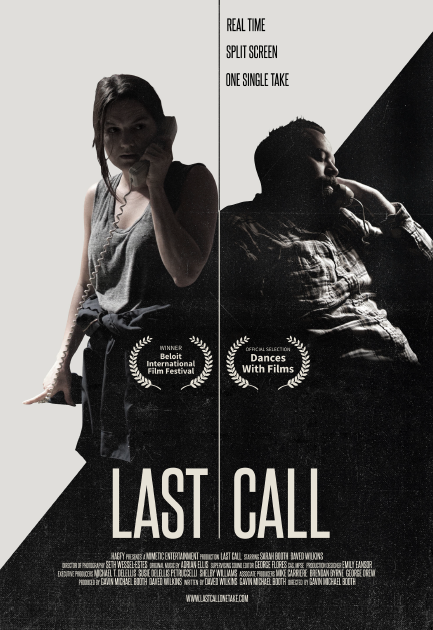
Shot in two single, real-time takes in different parts of Windsor, Ontario, Last Call is a 76-minute spit-screen phone conversation between Scott (an alcoholic trying to reach the suicide hotline on the anniversary of his son’s death) and Beth (a graveyard shift janitor who picks up the wrong number).
This isn’t a heavily edited movie that uses the best takes to sew together a story. Last Call is a single-shot film where every player on set and off worked together simultaneously to create exactly what you see on screen. No fine tuning. No splicing. Just the mounting tension of two characters trying to save a life.
We asked Montreal native and recent winner of the ACTRA Walter Massey Breakthrough Artist 2018 award, Sarah Booth, what it was like to work in unique and challenging conditions conditions with co-star Daved Wilkins and director and husband Gavin Michael Booth.
CU: Last Call is a really different approach to cinema, storytelling, and even viewing from the audience’s POV. What drew you to the role?
SB: What drew me to this role was the subject matter and the way they were planning to shoot it. Gavin loves challenging the medium, being curious and creative. When I was pitched the idea, I felt a rush and I knew it was the right project for me. I love adrenaline. I love to be challenged. Knowing that anything can happen made my heart beat.
The viewers are with the characters for 76 minutes. No cuts. It allows them to participate in a human experience and gives them a chance to see two regular people doing regular things, but having an incredible impact on each others lives. It’s as real as you can get in film.
It’s a complicated dance between overwhelming excitement and anxiety. You have to find the space beforehand to experience both and then put it away and focus. My heartbeat would start to slow down about 15 minutes into the take. Once things really got going there was no turning back.
CU: Single-shot scenes—let alone full movies—are a rather rare and compelling piece of cinematography. How did you feel going into it?
SB: We had to trust technology, each other, random strangers on the street… you name it. We developed a great attitude of anything can happen, so be mentally prepared for it. We have to flow. I had the most interesting relationships develop with my co star Daved Wilkins, who also co wrote the film, and my camera operator, Seth, who also was the DP of the project. I could tell when Daved needed my help on the phone and vice versa. Seth and I would create great shots and not even look at each other. We made up tiny signals for emergencies. It was so cool.
I feel incredibly fulfilled by this experience. It was hard, it was a little ambitious, but we did it. And people are reaching out to us with their own personal struggles. That’s more than we could have ever asked for.
CU: What was your experience like making this movie compared to what you saw on screen when it was complete? Was is like layering on a whole other depth, or bringing two movies together for a complete story?
SB: What was really interesting about creating this film is that Gavin would put every rehearsal and real attempt next to each other every morning. We would shoot from 10 p.m. to 6 a.m., and by 7 a.m. we would watch what we’d filmed. The first time we saw it, we knew something wasn’t working. We knew we would not have the luxury of editing the film afterwards, so Daved and Gavin rewrote the script as we were blocking, lighting, and rehearsing. There was no point in shooting a script that doesn’t work.
Gavin was extremely creative with how it came together. He worked with George Flores, our sound engineer, and used sound to guide your attention on screen. Then our composer brought it all home. When I watched Last Call with the score, which was also done in one take, I lost it. It is what brings all the pieces together. That’s when I knew we had a special film.
Last call will be playing in Montreal on Wednesday October 9 at 7 p.m. at Cinéma du Parc.


