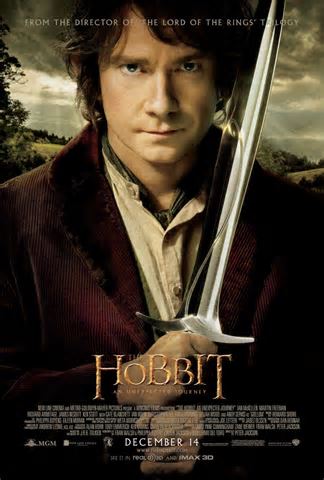
 The Hobbit: An Unexpected Journey
By Joseph Rossi for Curtains Up
Bilbo Baggins is a hobbit who would rather read a book in his living room then go out on an adventure. That is until the wizard Gandalf and 13 Dwarves take him on one to fight a fire-breathing dragon. And so begins The Hobbit….
That’s the setup in nutshell.
After Peter Jackson’s original Lord of the Rings trilogy earned billions of dollars, worldwide acclaim, Oscar gold and millions of elf-ear toting fans, a film version of The Hobbit seemed inevitable. Many waited in sweet anticipation and when Peter Jackson unveiled his first chapter of his latest trilogy last December, people balked. No love. No admiration. Nothing.
Whatever critical acclaim Peter Jackson received for those first three films was gone. Critics turned their backs, citing the films excessive length to be a problem. Many fans were disappointed in the juvenile tone of the film and plenty were turned off at the supposedly innovative 48 frames a second presentation.
What happened?
To be honest, I like the movie. Really, I do. Does it reach the heights of The Fellowship of the Ring? Not really. But maybe that’s because since 2001 we’ve had countless copycat films being released every 6 months (In the Name of the King anyone?). FOTR was one of the first fantasy films since the original Star Wars that felt fresh so it’s natural for The Hobbit to feel a little bit stale. It’s the been there, done that syndrome.
Then there is that whole 48 frame business. Watching it at a higher frame helped the 3D conversion greatly. I usually get headaches with 3D films but this one was perfect. Never took the glasses off once. It also had a great effect on the clarity of image. Special mention to Andrew Lesnie for his amazing cinematography. Truly epic work. But the effect that 48 frames have on the actors makes them look as if I’m watching Coronation Street on the BBC. It’s too quick. Too real. There are interviews of Peter Jackson saying that his experiment brings a sense of reality to the film. Well, that to me is the complete contradiction to what movies are about. Fiction films are an illusion, not reality. Even the most serious and prestigious films are make believe. So why would anyone want reality? In a fantasy film no less?
So I saw the film again on BLU RAY in 24 frames and much to my surprise I enjoyed it more. It looked like a real movie. It felt as if it could now be part of Jackson’s Rings opus. As the first part of a planned trilogy, it does suffer from its length; a little less than three hours to summarize the first 6 chapters of a children’s book seems a bit much for its true target audience. But there are many aspects worth noting for the casual filmgoer and their kids. It plays as a great swashbuckling adventure with some amazing set pieces and cool creature effects. Story wise, I call it Tolkien 101 or if you will, Tolkien lite. Jackson and his screenwriters chopped up the rather short novel and fattened their adaptation up with tidbits from The Lord of the Rings Appendices. It plays like an introductory course to the previous series of films (whose events occur after those of The Hobbit). Seeing that The Hobbit was originally written with children in mind, the tone of the film is more comedic and the plot less complicated which is a plus for families with 10 year old children.
Much to like are the performances. Martin Freeman’s Bilbo Baggins isn’t a carbon copy of what Ian Holm did in the first installments. His Bilbo is a nervous homebody whose idea of an adventure is basically trying to figure out what herb to season his fish with. Ian McKellen is back as the wizard Gandalf and like before, he brings compassion and warmth to the role. Ring’s veterans Elijah Wood, Cate Blanchett and Hugo Weaving all make welcome appearances. One issue I have is with the 13 dwarves. Aside from the leader of the group, Thorin, played with stoic nobility by Richard Armitage, none are really fleshed out. Maybe we’ll have to wait for the next two films to get to know them better.
In the end the true star is Jackson. His direction is fluid; his camera swoops and glides around action scenes with great choreography and timing. Say what you will about the film itself, his passion is visible in every frame. He obviously loves his material if he overstuffs this package like a holiday bird. He just needs to know when to pull back a bit and let the characters just talk and a scene breath. He restrains himself in one scene in particular. The “riddles in the dark” scene where Bilbo must use his wits to avoid being lunch for the creature Gollum, played wonderfully again by Andy Serkis, is the highlight of the film. Simple wordplay and expect cutting make the scene darkly comic and nail-bitingly tense. If there were more scenes like this, the movie could’ve been great. But we’ll have to settle with just plain good. And for now, seeing the slim pickings in the epic fantasy department, I’ll take what I can get.
