By Joseph Rossi for Curtains Up
The musical is my favorite genre. For me it was the one form to fully capitalize on the idea that Hollywood was and still is a dream factory. And what is more dreamlike then having a person burst into song and dance on a whim. Movies like Singin’ in the Rain, Meet Me in St. Louis, and Show Boat are all great examples of what old Hollywood did best. Chicago, Dreamgirls and the recent Les Miserables are more current but it’s safe to say that the genre is as popular as ever.
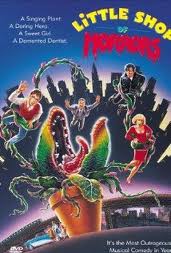
The first musicals I was introduced to were the Walt Disney musicals of the 60’s and 70’s. Was I enthralled? Perhaps. I was a toddler and they were pleasant diversions. But it wasn’t until I was older that I watched my very first live action musical, Frank Oz’s 1986 gem, Little Shop of Horrors. To this day this campy, silly movie about a man eating plant from outer space is one of my favorite movie musicals. Is it better than anything Stanley Donen and Busby Berkeley did? Not really. I just prefer it. Not arguing with anyone here. My preference. That’s it.
It stars Rick Moranis as Seymour Krelborn, the hapless flower shop employee who naively nurtures a weak little seedling into becoming a villainous, blood thirsty, man eating, soul singing plant. The film is based on the stage musical, itself based on an old Roger Corman film of the same title. The songs and score from Alan Menken and Howard Ashman are of the pop variety. Their lyrics have a tongue and cheek quality to them but there is darkness beneath.
What I love about the film is that it is a commentary on consumer gluttony told through song. The film opens in a poor urban area known as Skid Row where we meet Seymour who works at Mushnick’s Flower Shop. Times are tough all over so Seymour decides to unveil an unusual plant that might drum up interest and business. Not long after, people start pouring in just to look at this plant. Seymour becomes famous and everyone wants a piece of him and more so, a piece of his star vegetable.
Seymour’s dirty little secret is that the plant, which he names Audrey 2, after Audrey, his beautiful and loopy co-worker, is an alien who thrives on human blood. When the plant develops a voice, it becomes the devil is disguise, manipulating Seymour into murdering for food, thus keeping it healthy, the people interested and the money flowing in. The plant becomes so popular that the eventuality is that everyone in America will want their own, thus creating the scenario that this alien plant will take over the world.
What the film wisely does is keep the vibe from the stage show. It may be about an evil alien trying to take over the earth — but it’s funny. The film is filled with enough comedy to satisfy any SNL fan. Bill Murray, John Candy, Christopher Guest all have winking cameos. Steve Martin is here too, playing a sadistic dentist. One has to see it to believe it. It is one of Martin’s best performances. He has a killer song too. Another wise decision was to make sure the film keeps its obvious backlot feel. The flower shop looks like a set; the street, the buildings, the sun and the sky all look fake — and it’s wonderful. Just like the obvious sets in any old time Hollywood film, director Frank Oz brings us onto a stage.
Two of biggest coups was the casting of Ellen Greene, the original Audrey from the stage show, and Levi Stubbs of the Four Tops as the voice of Audrey 2, the plant. Greene is a powerhouse. She rips through the score with gusto. From the sweet “Somewhere that’s Green” to the uplifting “Suddenly, Seymour”, she’s the heart of the show. She and Moranis make a sweet pair. The tall, blond and ditzy girl who falls in love with the short, bi-spectacled, plant enthusiast. Only in the movies.
And then there is Levi Stubbs. If Greene’s Audrey is the heart of the movie, Stubb’s Audrey 2 is the wicked soul. And what a soul it is. He roars through his numbers with a toe tapping sense of conviction. One could imagine how hard it must’ve been to match the plant’s lip movements with Stubb’s rapid fire delivery. But they do it and by the time we get to Stubb’s show stopping final number we believe that we are watching a living, breathing plant with the voice of a demonic angel.
By all means this isn’t the quintessential Hollywood musical. Film classes won’t show it; it never shows up on anyone’s radar and it’s never on anyone top 100 lists but — who cares. It is a good time. It has great music, a clever, cheeky script, great performances and above all else — it has heart. Check it out.