By Richard Burnett
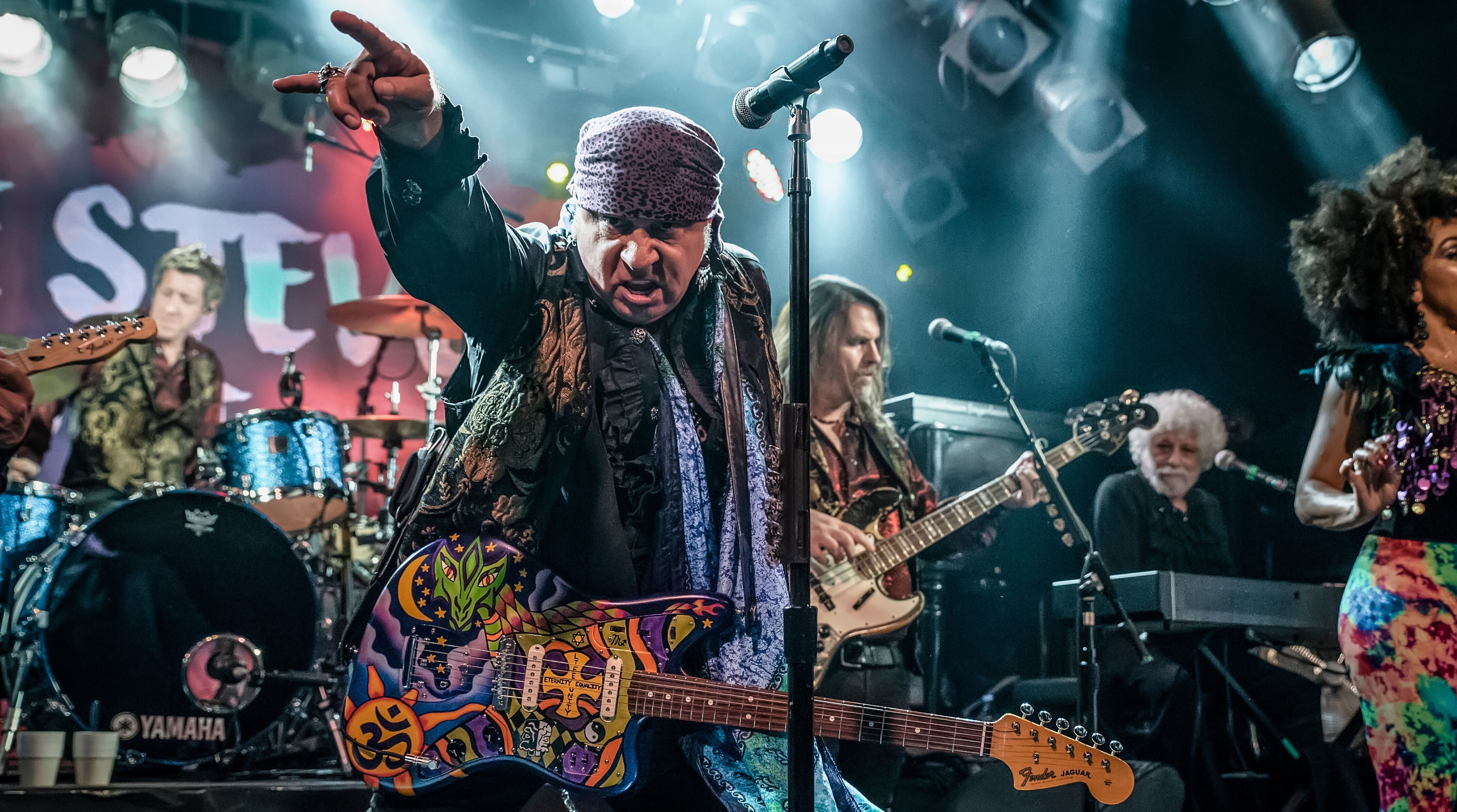
The last time rock legend Steven Van Zandt performed in Montreal solo, with his band Little Steven and the Disciples of Soul, was in October 1987 when he opened for U2 on their Joshua Tree Tour at Olympic Stadium for more than 66,000 screaming fans. Los Lobos was also on that bill.
“Really? That was our last Montreal show?” an incredulous Van Zandt asks me when we settled in for a recent 30-minute interview. “Wait until you see our new show!”
While Van Zandt did return to Montreal over the years as guitarist in Bruce Springsteen’s E Street Band – he was a founding member after creating the “Jersey Shore” sound with the Asbury Jukes – his upcoming July 8 concert at the Olympia Theatre is the city’s most anticipated concert of the summer.
Opening the show is Van Zandt’s old pal, New York-based rocker Garland Jeffreys who recently retired from touring and will perform his final Montreal concert.
In our interview, Van Zandt generously talked about anything and everything – nothing was off-limits – from the night he first met Springsteen to co-starring in all seven seasons of The Sopranos.
We also talked politics – from Artists United Against Apartheid recording Van Zandt’s landmark 1985 protest song Sun City to the cultural boycott of Israel – and about the just-released Summer Of Sorcery, his first full album of new material in 20 years.
Curtains Up: The critics are raving about your new album Summer of Sorcery. But it isn’t personal or political. Why did you decide on this new approach?
Steven Van Zandt: My reconnection to my own music was a complete accident, really. In Soulfire (from 2017) there are some offbeat songs, and there’s a certain value to these songs that are forgotten about. The reaction was amazing. So I wanted the follow-up to be just as strong, or stronger. I said, “If there is going to be a follow-up, I want it to evolve.” Unlike my albums from the 80s, I did not want it to be political or autobiographical. So I wrote songs like they were movies, with a character in each one, and it turned out to be a major artistic breakthrough for me.
You created The Rock and Roll Forever Foundation and your 2018 “Soulfire Teacher Solidarity Tour” benefitted the Foundation’s TeachRock program. On your Summer of Sorcery Tour, you are giving free tickets to teachers, including 200 tickets to teachers for your Montreal show. Why is this important to you? Why are our teachers so important?
I feel like they are the most underappreciated and underpaid members of our working class, of our culture, and our whole future depends on them. We (The Foundation) created an entire music-history curriculum for them to use. I thought our generation would be the biggest in history, but this (new) one may be rivalling that. They are smart and they have no patience, and the old teaching methods of “Learn this now and one day you’ll use it” is just not going to work with this generation.
So we thought we’d do something a little bit more radical and use music to get their attention, and keep it, and it’s been working. Teachers can use our curriculum for free. On tour we usually do a workshop between the sound check and the show, we’ll see if we continue that (on this tour), but teachers can still come to the show for free. We’ve already registered 25,000 teaches and we’ve just started the process.
(Editor’s note: To get tickets, teachers should visit teachrock.org/tour, find their date and register.)
I am a huge fan of Nigerian roots-reggae star Majek Fashek, and his album Spirit Of Love which you produced. You also co-produced the Bruce Springsteen and the E Street Band albums The River – including Springsteen’s anthem Hungry Heart – and Born in the U.S.A. You’ve produced albums for Southside Johnny and the Asbury Jukes, Gary U.S. Bonds, Ronnie Spector and Arc Angels. What is it like to produce other artists? Do you hear things differently when you produce others?
I have almost gotten to the point where I can be objective about my own work. The truth of the matter is you really should not produce yourself. Obviously you are more objective (when producing others). You get a sense of what they want, and also what they need. It’s a tricky balance to produce somebody. You need to have a good relationship; it’s a very important one for the artist. It’s a matter of trust, you get very close in those situations, and some artists can’t necessarily verbalize what they want, so you kind of have to read their minds. It’s a challenge, but I love it.
In 1985, you formed Artists United Against Apartheid and wrote Sun City. I grew up in a mixed-race family, we come from the tiny island nation of Mauritius in Southern Africa. I was 19 years old when I bought your record. It was important. I was wondering what your thoughts are today about the effect of your Sun City protest record?
It was one of the most successful political records and projects in history. We had 50-some artists on the record. We intended to bring the South African government down and we did. We got Mandela out of jail. It was very satisfying, very rewarding, and I’m glad we did it then because I’ll tell you what, you probably could not do a record like that now.
I think you’re right. Just yesterday I was reading a terrific interview you did with Dave Marsh in 2014, in which you talk about Paul Simon recording tracks for his Graceland album in South Africa in 1986, in direct violation of the cultural boycott. What do you think of artists who violated the cultural boycott of South Africa?
We had an important meeting about it and I felt strongly that we should feel united about that. Many artists violated the cultural boycott but let’s give them the benefit of the doubt and say they were taken advantage of and manipulated. There was Queen and others. I just said, “Look, just tell them you’re not going to go back and I’ll get you off the U.N. black list.” There was a serious black list – if you were on that list, man, you’re gonna have trouble working. Paul Simon was the only holdout who never really gave it a thought. He maintained his position the whole time and to this day he still thinks he’s right.
How do you feel about the present cultural boycott of Israel?
It’s not one of my big issues. I don’t think it’s going to work. I’m very skeptical about boycotts in general. I did a major amount of research before I did it in South Africa. I talked to a lot of people who knew it was the right thing to do down there.
For Israel, they’re our friends, if something is going to get done, it is going to get done behind the scenes without these foolish threats with no muscle whatsoever. They’re completely hollow threats. It’s a very adolescent movement, to be honest. They’re very ignorant and being very idealistic about it without any practical usefulness.
Plus, I would go one step further than that and say that I would never support an extremist liberal country. As long as Hamas is running things (in the Gaza Strip) – and I’ve read the Hamas mission statement and all of their literature – they are not the kind of people you want to support. The Palestinians are going to have to sort out their domestic situation because as long as Hamas is there, it’s going to have a problem.
You launched your nationally-syndicated Rock and Roll radio show Underground Garage in 2002. I love how MTV describes you as “the coolest DJ in the country, a proud throwback to the late-night hipster jocks of long-gone 1960s and ‘70s FM Radio.” As a disc jockey, music historian and musician, what was it like for you to be inducted into the Rock and Roll Hall of Fame as a member of the E Street Band in 2014?
When you consider who else you’re in there with – and it’s quite a remarkable group of people – it feels wonderful. I’m also on the nominating committee and we have a tough time each year, believe me, because there is a lot of people who deserve to be in. It’s very difficult to get in and overall I think we tend to do a good job getting people in. I wish we could get more in a little quicker but generally speaking I think the Hall of Fame does a good job.
For many, the three faces of the E Street Band are Bruce, Clarence Clemons and you. After Clarence passed away, was it hard to play without Clarence?
It was quite a traumatic moment. Losing Danny (Federici in 2007) was also terrible. As for Clarence, you realize it’s never gonna be the same. First of all, if we’re going to continue, we had to continue as a different E Street band. And Jake (Clemons, saxophonist and the nephew of Clarence, and who moved to Montreal in 2017) was a bit of a miracle. That he was a nephew really helped with the transition, but at the same, during that first tour, we decided we’re not going to put him in that position onstage. It would be too much pressure. So we took out an entire horn section for the first time, really, and Jake emerged from the horn section to play the solos and then go back to the horn section. That was a nice way of making the transition and now everybody has accepted him as the man.
When Bruce inducted you into the New Jersey Hall of Fame in 2018, he recalled the night he first laid eyes on you at the Middletown Hullabaloo Club in 1966. I believe you were performing a cover of the Turtles’ Happy Together with the Shadows. Do you have any memories of that first meeting?
I do. I remember that first meeting. It would have been in 66, or end of 65, actually. Everybody had a band in their garage, but not that many bands were actually out there playing. You had only about a dozen bands in the entire area. So you got to know each other. We were just a bunch of freaks out there hoping we could somehow make a living from it.
In the end, I think me and Bruce bonded particularly because we realized we were the only ones really had no Plan B in life, you know. We were the ultimate freaks. There was no chance for us. We weren’t going to make it in college, the military, or our fathers’ job, or anything in the straight world. Rock and Roll was our religion. We both shared that obsession and that helped us to bond rather quickly and become the best friends that we have been ever since.
You created the character of Silvio Dante in The Sopranos.
Yeah, in a television treatment. It wasn’t a completed script at the time – it is now – but I had him as an independent hitman and he ran a Copacabana-type club. I called (Sopranos creator) David Chase, it went to HBO and they said, “Nah, can’t afford that, so we’ll make it a strip club.” And that became the Bada Bing! strip club in The Sopranos.
Would you like to do more acting?
I want to. It takes six months to do a TV series, so I’ve been having trouble deciding which six months.
What will we see at your Summer of Sorcery Tour concert in Montreal?
I can guarantee you will have never seen a 15-piece band this good! This will be the best 15-piece band you ever see live. We got all the best New York musicians and we’ve been together two-and-a-half years now. You get really good the longer you’ve been together. It’s a powerful show, with five horns, three girl singers. This is the first time in my life that I’ve ever done two (solo) records in a row with the same band. It’s been really rewarding and I appreciate their loyalty.
Last question: What is it like to be a living legend? Because you are, sir.
(Laughs out loud) A living legend is a celebrity who is broke!
I dunno, I really don’t feel like I am. I’m just grateful I got a lot of ideas and have had a major artistic breakthrough at this stage of the game. I see a whole new future filled with music and more TV shows I want to do. We’re going to get together with Bruce to see what he wants to do next year. So lots of ideas, lots of possibilities, I feel I have a lot more to deliver.
Little Steven and The Disciples of Soul bring their Summer of Sorcery Tour with very special guest Garland Jeffreys to the Olympia Theatre (1004 Ste-Catherine E.) on July 8. Showtime: 8 pm. Tickets: $65.00, $49.50, $39.50 (taxes included / service charge extra). Visit olympiamontreal.com to purchase tickets, and visit littlesteven.com for more Little Stevie.
Music video of Garland Jeffreys performing live with Lou Reed and Little Stevie:


