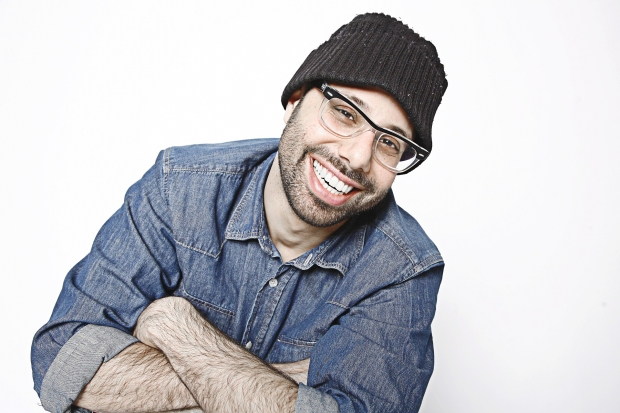
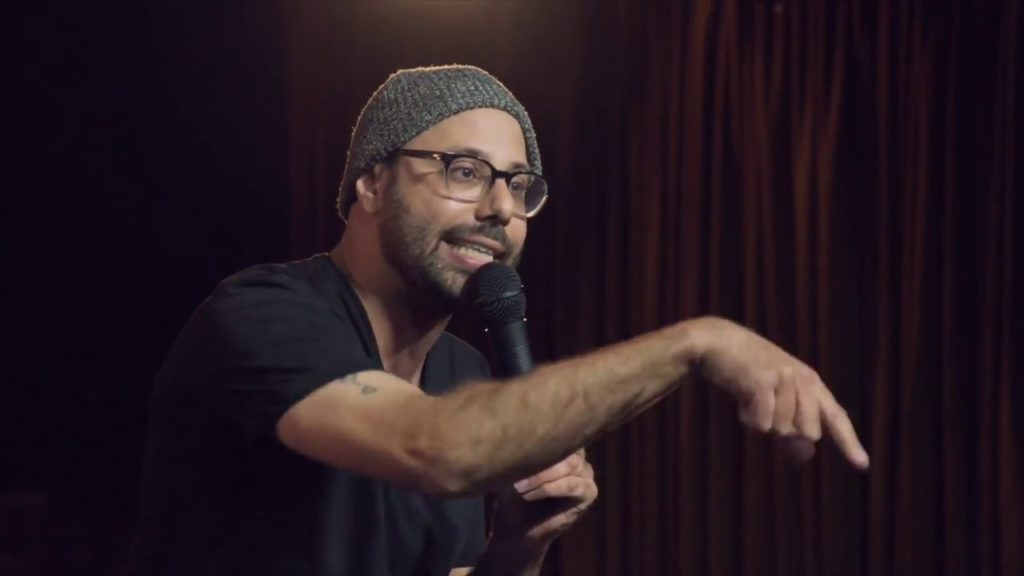
2019 JUNO-award winner for Comedy Album of the Year (Good Friend, Bad Grammar), Dave Merheje is one of Canada’s finest when it comes to jokes. Having grown up in a first-generation Lebanese-Canadian family, Dave’s personal life has a huge influence on his humour. Dave got his breakthrough into Canada’s professional comedy community as one of Just for Laughs’ “Homegrown Comics” back in 2011.
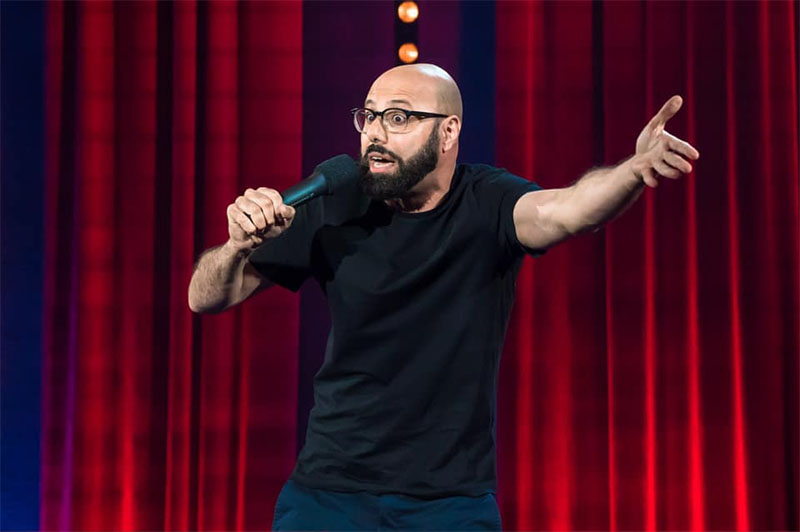
In 2018, Dave was one of four Canadian comedians (others being K. Trevor Wilson, Ivan Decker and Deanne Smith) selected to tape their own live half-hour special at Club Soda for later live-streaming on Netflix (Comedians of the World).
Having worked the Canadian comedy-circuit professionally between 2011 and now, Dave is now back at JFL as a regular in the lineup for this year’s 19-show run of “The Ethnic Show”, hosted by Cristina Alonzo, with an all-star lineup announced so far, including comics Donnell Rawlings (Jay and Silent Bob Reboot, Joe Rogan, The Last OG), Robby Hoffman (Baroness von Sketch, Odd Squad), and Anthony Devito (Stephen Colbert, Gotham Comedy Live, Adam Devine’s House Party) as well as being booked for his own solo show in the OFF-JFL programming (Catacombes, July 22nd).
Not at all stranger to Montreal, with many previous performances at The Comedy Nest over the course of many years, Dave’s spots on both The Ethnic Show as well as his own solo show as part of OFF-JFL are promising highlights to this year’s JFL and OFF-JFL festival lineup. To find out more about Dave’s success and what has led him to this point, we sat down for an interview with Dave during his recent visit to Montreal.
Curtains Up: Congrats on your sets coming up at this year’s JFL – How can you best describe your new material for this year’s coming JFL?
Dave Merheje: I think I’m tryin to talk more about the anxiety… my anxieties and my family’s anxieties. My sister has a pretty intense anxiety, my dad has it, raising us and where he came from, leaving his country to start a new life and stuff like that.
You got your start of a professional career through Homegrown Comic competition with JFL – Can you explain some of that process? How did it lead to now?
That was back when I was bangin’ the pavement in Toronto, just trying to get a footing. JFL Homegrown in 2011 opened up opportunities for me and let people see to see me in a proper way. 7 minutes, back then I was very loose, and I didn’t go off the rails on some things, more contained in what I was doing in a proper presentation, and it helped out.
And how did it lead to now?
That was the way I introduced myself to the festival and to Montreal, and I kept working harder from there. It just led to other opportunities that I kept building on.
What advice would you have for comedians who are just getting to that stage where they’re landing OFF-JFL/Zoofest shows aimed at showcasing new talent?
Have fun! I feel like these are pressure situations sometimes, and nerves can get the best of you, which you’re still gonna be nervous, but you have to fun with it and be prepared. If you put all the work into it, it’ll make sense and it’ll come out proper. If you’re constantly working and getting on stage all the time, you’re gonna be sharp. If you go on stage twice a week and then go on to one of these shows, it’ll show in the work.
You recently won a JUNO – that’s a newer category to have come back at the awards, how has that changed your career?
It hadn’t been in the categories in years. They brought it back 2 years ago, and Ivan Decker won it the first time it was back. Ivan’s great. Ivan won it and I don’t know why it wasn’t around for a long period, but I think it is such great to recognize the great pool of comedians in Canada in general. This really helps people in Canada listen to albums and be up on comedians.
How did you choose the jokes for that album?
“Good Friend, Bad Grammar” was recorded as a live album. My thought wasn’t for it to be an album at first. I thought “Let’s record this live special and try to sell it, pitch it to different streaming services”. From there, it was just like “well, let’s also put it in the album”. It was the live show, as-is.
For the upcoming Ethnic Show, in your opinion: is there ever anything that you don’t want to joke about, or feel like is a “no-go” zone or a line that shouldn’t be crossed?
There’s not necessarily a line. I only like to talk about what I could answer to. I don’t like personally talking about things I don’t know about, or like I’m not an offensive person, it’s not in my nature. I just talk about the things I like to talk about. If you think it’s not edgy or interesting, it’s up to you. I’m not going to be up there doing something that’s not me. For people who are pissed at me, I probably have crossed the line, but I’m not out here talking about the darker topics.
What can audiences expect at your Off-JFL solo show at Catacombes?
I’m talking about older experiences that I’ve had, and again, more about the anxiety and how it affects our family, and my dad. Reviewers often think it’s just another immigrant story and all, nothing fresh about that, but an accent isn’t a thing you put on for a show. An accent is a tool when it is these people’s lives. My dad’s accent is his life, he can’t turn it off. I want to explore that more and show more affection to my family. It’s how I show affection – he gets it. I’ll just say I love you, and he’s not as vocal as my mom. We used to joke like “Yo man, I love you”, and he would be like “Yeah” [Laughs]. He would try to avoid. He does say it more now. He has come open a bit more, for sure. He cried at the JUNOs, but it was very quick. He tried to like, fix me up. I think I’ll share more of that at my show, which I’ll enjoy.
Some of your material revolves around your parents/family – how do they handle your career making fun of them?
You know, I wasn’t even talking about them as much at first when I was trying to find my style and my voice, it’s just that they’re good stories. I would tell a comic (who passed away years ago), I would tell him a story – and he would say “why aren’t you saying this on stage”! It could be any ethnicity, and my dad was a guy would be going down the street to the Tim Hortons to save ten cents, but wasted that in gas to get there. He raised us and he knows what he’s doing, but some of the things he did were funny in that they didn’t make any sense. Our last name, he told us, is MERHEJE, but he told us there’s also MERHEJ. I asked him if our name was a different spelling, and he said it was – he panicked and added an extra E at the end of our last name when he got to Canada to try to blend in better. Just stuff like that, I feel like I should be talking about and sharing. My parents, they’re totally cool with it.
When did you start getting into comedy? Who are your influences?
My dad is for sure an influence. My whole family is very funny. My mom is funny, in the way she disses you. My brother can tell stories, my dad tells stories. They’re very much an influence. Richard Pryor was a big influence, and still is. Mike Epps, Nathan MacIntosh, Sebastian Maniscalco, and as you go on you keep finding new influences, people like Bill Burr.
I think at 14, my uncle Brian would show me videotapes of Richard Pryor, Andrew Dice Clay, Eddie Murphy. I saw this Richard Pryor bit in which he’s pretending to be a heroin junkie and wino talking to each other, and the wio like helps the heroin junkie shoot up kinda thing, I saw this with my mom and I was like “Yeah, I really want to do that!”… meaning the comedy, not the drugs! [laughs] The performance was so magical.
You joke a lot about your family – if this was a norm growing up, at what point did you find their quirks hilarious, and great material for jokes?
I think when I was like 9, I remember I dissed my aunt in front of my mom and my mom started to laugh. I don’t know how to explain it. I know my grandmother would get up and leave the room sometimes as we got funnier, like–what did we just do?! As I got older, I realized some of the stuff my dad did was always funny. Even if I wasn’t doing comedy, it was always funny around my house. Even when we were in dark periods, we find a way to somehow laugh, whether it was my dad doing some sort of antics, or I remember my mom telling us that my dad had cancer – and it was funny because we all met at a restaurant, and they were waiting to tell me at the right time. My brother showed up late at the restaurant and was like “Hey, so did you guys tell him?!” My mom goes “what the f*** is wrong with you?!” while she trying to order food and have a conversation with the waitress, while telling me my father has cancer [laughs]. At the moment, it was very, very sad for me, but I think after as I look back at it, the whole thing is hilarious. They could have just said it back at the house. My mom was there at the restaurant, like “It’s not that bad, it’s just prostate cancer—can I get a salad?” and I was devastated. They didn’t tell me until like 3 months after, so the example like that is that stories like that just happened all the time for me growing up. Even in aggression or a sad moment, humour comes out of it because of the people involved.
Two last questions, A lot of your humour is based on your own experiences. With the way the world is going right now–as we age and new trends appear that may seem ridiculous to us, do you think it’s going to only be easier to write comedy in the years to come?
You know, I try in personal observations and jokes, to not alienate anyone. I listen to a lot of rap music, and just from that example (rap), I try to not judge a new generation of rap while I’m listening to it. I try to put that into other things and aspects of my life. I try to enjoy new creativity because I think you stay fresh that way in a sense that you grow instead of just locking in, y’know what I mean? Being like “All these young punks, they just being…”. I’ll still do it, I’ll still scream at them in my jokes, but anger is good at times, it’s like anger and anxiety… venting just relieves it for me. I should still probably still see a therapist, that’s why. [laughs–short pause…] Yeah, should definitely see a therapist [still laughing].
What’s next for you, after The Ethnic Show, your solo show and JFL?
After JFL finishes? We start filming season two of Ramy (Hulu) in New York, this fall!
Just for Laughs’ The Ethnic Show runs July 10th through the 25th at Club Soda (July 10-19) and MTelus (July 23-25). Dave Merheje’s solo OFF-JFL show runs one-night only at Catacombes on July 22nd at 8:30pm.
More information and tickets for both shows are available at hahaha.com