By Andreas Kessaris for Curtains Up!
“Whenever one group displaced the other at the top of the music charts, the news ran under a screeching headline, as if the Beatles and the Stones were football rivals or opposing candidates in a high-stakes election.”
-John McMillian
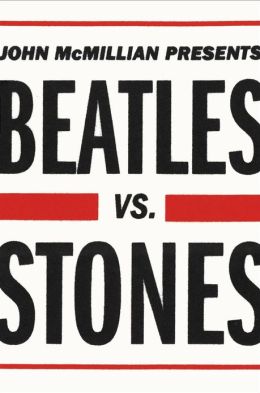
Coke or Pepsi? Mac or PC? Maple Leafs or Canadiens? Letterman or Leno? Some people, places, items and institutions are destined to be considered forever rivals. (And the ones we side with can say quite a bit about who we are as individuals). For rock and roll the eternal question remains: “The Fab Four” or “The Bad Boys of Rock?” Author John McMillian takes on that conundrum in his latest book, succinctly titled Beatles vs. Stones.
John McMillian is neither a music critic nor a rock journalist; he is in fact an assistant professor of history at Georgia State University. He approaches the subject with the seriousness of a scholar but he keeps the text mercifully direct and uncomplicated; one does not have to be an academic to appreciate the work. From the first well-composed sentences in the introduction I had high hopes for Beatles vs Stones. He begins with some helpful suggested listening to give us historical context and put us in the correct frame of mind.
Throughout Beatles vs Stones the author parallels their careers and compares their early influences, personal histories, musical styles, characters, and even their management. McMillian wisely keeps the bios and anecdotes short and understandable. As a result the work is well-paced, there are no redundancies, and if you knew little about both bands to begin with, it’s a consistently delightful read. The author’s analysis is insightful and his observations are solid, making the aforementioned passages the most original parts of the book.
Which brings me to what I didn’t like: McMillian did not interview anyone for Beatles vs. Stones himself, instead relying entirely on old interviews, memoires, press clippings, and other people’s research. As a result, (at the risk of sounding immodest), it contains few real surprises or revelations for myself or any well-read, real fan of that era’s popular music.
Another problem is that, as far as the members of the bands in question were concerned, there was no actual rivalry, (it was more an invention of the press to sell papers), and they shared, by all accounts “a very friendly relationship” (Page 43). As odd as it feels to say this, if the Beatles and Stones were in reality more bloodthirsty, bitter rivals, the book would be, at least for me, more compelling. Instead we have countless incidents where they helped each other, cooperated, and exchanged sincerely kind words in the media. (Yawn).
In the end McMillian allows us to draw our own conclusions, which in some ways is a bit of a cop-out, (after all, if you call your book something as provocative as Beatles vs. Stones, one might expect there is somehow a winner in all of this other than the record companies), but honestly the more I think about it, the more I appreciate that he respects our intellect enough to present us the facts so we can make up our own minds.
And to answer the questions posed at the beginning, for me it is Coke, PC, Canadiens, Letterman and The Beatles all the way!

