By Andreas Kessaris for Curtains Up! (@AKessaris)
“Remembered as a ‘textbook example of mass hysteria,’ the War of the Worlds panic is still cited constantly by historians as evidence of the anxiety permeating the country just before World War II. The broadcast itself has become shorthand for the dangerous power and influence of the media, not to mention the gullibility and ignorance of mass audiences. Whenever viewers mistake a mockumentary for the real thing…the incident is invariably referred to as another War of the Worlds.”
-A. Brad Schwartz (from Broadcast Hysteria)
Imagine, if you will, a new technology is introduced that revolutionizes information and entertainment and takes the world by storm; an electronic communication system with no clear rules, and anyone can say or do just about anything, like report fake news or pull a prank or hoax that causes a panic. Imagine politicians and demagogues denouncing the new medium, claiming it is corrupting the population, and trying to regulate, and some may say, censor it, for reasons that are not always in the public interest, despite what the aforementioned leaders may assert publicly.
The internet, you say?
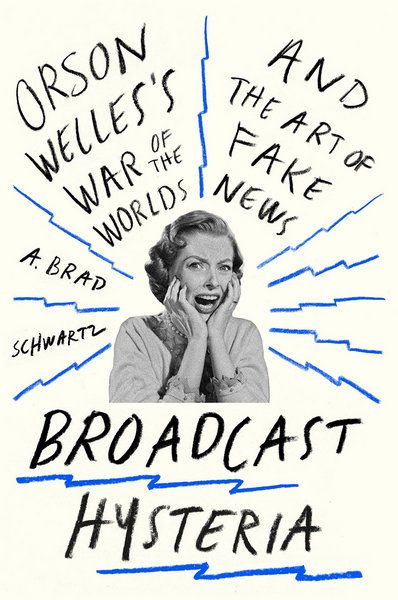
No, I’m talking about radio in the ‘30’s. The eerie parallels between the early days of broadcast radio and the new online digital world, centred around the Mercury Theatre’s infamous adaptation of H.G. Wells’ science fiction classic, is the subject of Broadcast Hysteria: Orson Welles’s War of the Worlds and the Art of Fake News, a new book by A. Brad Schwartz.
In Broadcast Hysteria the author cites the numerous, and mostly obscure, letters (for those of you who don’t know, letters were sent through an agency called a “post office” for a small fee…just think of Twitter on paper that takes a few days longer and has no serious limits as to how long it could be), written to the federal government and Orson Welles supporting and praising his version of War of the Worlds for its quality, daring and cleverness, unlike what we have been led to believe over the years. (I had always regarded as genuine the accepted story that it inspired wide-spread terror and infuriated those who were fooled; both of which it turns out were monstrously exaggerated by people looking to exploit the opportunity.)
Broadcast Hysteria is polished and intellectual, perfectly paced, and well-structured with endlessly surprising, original information; I was never disinterested. Schwartz knows what facts are pertinent and never gets trapped in the quagmire of pointless, unnecessary digressions or redundancies. His conclusions are smart, sensible and logically sound.
The effort reads like an academic thesis, and that is the only real problem: It is more like a dry, bland text than a commercially available trade book. But at least it’s a dry, bland text of exceptional quality.
And for my own part (and I have always fancied myself the iconoclast), I love any book that proves that something generally acknowledged as true is utterly and completely false.
*You can listen to Orson Welles’s original War of the Worlds broadcast on Youtube @ www.youtube.com/watch?v=Xs0K4ApWl4g …it still holds up today.*
