Weiyu Dang for Curtains Up
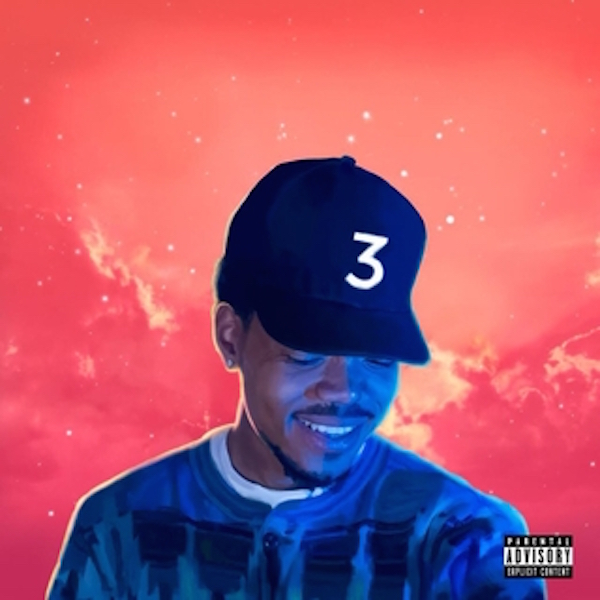
From the album cover art of Coloring Book, Chance the Rapper looks downwards in a protective, but appreciative stance that fuses notions of family both musical and physical. The sangria tinted backdrop of stars and clouds sets Chance on high in a frenzy of grateful communal creativity generic of gospel.
This third Chance mixtape culminates a recent rampage through the rap scene from debuting as the first non-label signed artist on SNL to featuring and writing on Kanye’s The Life of Pablo.
Family as a motif guides the thematic development of Chance not making “music for free, [but] for freedom,” here the freedom to make a family steeped in the mythos of the American Dream. Uniting gospel as both a sermon and a prayer provides Chance with a higher Father, God, that helps him become a father, a man in his own right.
With the opener, “All We Got,” music enters as Chance’s preferred route to finding a way to “turn [his] baby mama to my fiancée” and build a family. To overcome whatever hurdles are foisted upon him by structures he has no control over becomes his life thesis, the thesis of his prayers. His “Wish [to] tell you it’s ready / Tell you it’s ready today” is a dream to announce that the dream is available, at the very least, through the comfort created in music.
Though gospel is steeped in Christian heritage, Coloring Book provides a decidedly less theistic approach to worship by of praising the universality of family. The power of family as deity informs Chance’s navigation through pressures of signing a deal on “No Problems,” the failure of ephemeral youth on “Summer Friends,” and urban harshness on “Same Drugs.”
Family stands as the constant in a restless life in South Side Chicago. On “Summer Friends,” “when the plague [of violence and reality] hit the backyard,” comfort is among memories of the “summer friends [that] don’t stay.” Remembering the happiness of friends as family proves a salve as Jeremih croons “When I was so young before I could remember / I would always treat my gang like family members / Even when I changed, a nigga never changed up.” To preserve family is to preserve the self.
Yet, as voiced on “Blessings,” “Jesus’ black life ain’t matter, I know I talked to his daddy / Said you the man of the house now, look out for your family.” The body and plight of a black man doesn’t have a place among the ranks of American families. The way to gain access is to sacrifice the self before the family. To do so needs assurance. The interlude “D.R.A.M. Sing (Special)” supplies the requisite affirmation with a soul hymn of “everyone is special / these I know is true when I look at you.”
As much as gospel comes from a need to address hardship, it also keys in infectious dance grooves and a need to release through music. “Angels,” “Juke Jam,” “All Night” (produced by Montreal born Kaytranada), and “Smoke Break,” furnish the neo-disco fun. “Angels” serves as an invite to dance and relieve pain in the wake of having “too many young angels on the south side / got us scared to let our grandmommas outsides.” Chance presents dancing for the city as a community as the way to regale his dead friends, the “angels all around [him], [that] keep [him] surrounded.”
“Juke Jam” and “All Night” as a tandem builds a buffer between Chance pre and post fame. The tension between failures of youthful innocence and wary cynicism combine to preserve Chance for a final ascendancy into maturity. Aided by Justin Bieber on “Juke Jam,” the exploration of puerile love through juking offers a reprise from the burden of family. The drunken stupor of “All Night” purges the distractions that come with fame: “oh, you my cousin? / No you wasn’t, you just wanna ride.” The fake family that materializes doubles as temptation in Chance’s quest to maturity.
“How Great” pivots Chance from youthful lust to dedicated love and veneration: “My dream girl’s behind me, feel like I’m James Early / The type of worship make Jesus come back a day early.” With an appearance from Jay Electronica, “How Great” merges arcane religious devotion and a contagious and palatable message of belief. His final quatrain, “Mystery babylon, tumbling down / Satan’s establishment crumbling down / This is the year that I come for the crown / Bury my enemies under the ground,” pushes the mixtape towards a higher state of unity with God. The defeat of sins, or at least acceptance and rejection, fall to the gospel vibes of the songs choir.
Gospel continues with the celebratory “Finish Line / Drown” as Chance baptizes himself into a new adult life hinged on “[him] and [his] girl plan to stay to the end / hope there never come a day where [they’re] better as friends.” The resolve to settle down entrenches Chance’s rebirth and development. The encapsulatory “Blessings (Reprise)” summarizes Chance’s message “of wondrous unfamiliar lessons from childhood / Make you remember how to smile good,” a reminder of the deeper joy in trying to refind innocence.
Past all the trials on Coloring Book, a final choir of Ty Dolla $ign, Raury, Anderson .Paak, BJ the Chicago Kid, Donnie Trumpet and others asks Chance if he’s ready for his blessings and miracle. The blessings and the miracle don’t need reminding, moreso acceptance and acknowledgment. Family is his miracle.
To celebrate it is to live and create a miracle.


