By Michael Minorgan for Curtains Up
www.globalgourmets.ca michael@globalgourmets.ca
Pho Ba
When one visits Viet Nam it is impossible to avoid sampling this truly amazing dish found in restaurants and food stalls throughout the country, it’s practically a national dish and can be enjoyed at most places for a bit more than a dollar.
Pho originated in the early 20th century in Northern Viet Nam near Ha Noi. When Viet Nam was partitioned in 1954 many people fled to the South and pho, previously unpopular there, suddenly took off giving rise to many variations with the addition of different spices, herbs and vegetables not grown in the north. After the Viet Nam War vietnamese refugees brought the recipe with them to many other countries.
The heart of the dish lies in the great care of its preparation of the broth and the use of the many herbs and spices. Although this dish might not fit into the Quick and Easy qualifications of our weekly recipes it certainly conquers the Delish portion with flying colors. Pho is a great dish for those cold winter nights and the broth can be easily frozen for future pho cravings.
I am including along with this post instructions and comments by one of my favourite masters of Vietnamese cuisine, the Australian chef Luke Nguyen chef at the famous Red Lantern Restaurant.
This is the recipe and method I use every time I make this wonderful dish, so take the time and…..Enjoy!
According to Luke “Pho” is pronounced as “fur” but the end of the word goes up as if it were a question.
. “The hero of any pho is the broth” he says. “I was taught from a very young age to put a lot of love into the broth…for me if I have a bowl of pho and try the broth and I can see that it has been simmering for only two hours, I get very disappointed” “It needs to be at least eight hours – at least. Some are simmered for 20 hours.” He explains the time is necessary to extract all of flavour from the bones and vegetables.
The produce used in them is also very important as well as the treatment of the vegetables. “Put a lot of love into roasting your vegetables” he says. Luke chars the hell out of” the vegetables on the grill which brings out the flavours and then he removes the blackened parts so that it doesn’t colour the broth. And interestingly he uses pineapple to lend sweetness to the broth.
One need to use “good quality bones with lots of meat and lots of marrow in them too” he adds and unlike some advice which says to blanch the bones in boiling water he doesn’t as he feels that it washes away the flavour and instead he spends more time skimming the broth.
Pho is a dish that he often eats when he is sick. “A lot of families put in about five or so herbs, I put in around 13. Not only had the cassia bark, cinnamon and cloves but I put in a lot of a selection from Chinese herbal medicine.” He uses cassia bark instead of cinnamon as he finds that there is more flavour as well as Vietnamese cardamom and saw tooth coriander.
There are differences in the pho from the north and south of Vietnam. Luke’s family is from the south but he describes the North Vietnamese pho as “very clear, they don’t use a lot of the spices. In the south they pack in a lot of flavour and it’s a little bit darker.” The north pho is less likely to have the herbs, bean sprouts or sauces as it is colder there whereas they grow these abundantly in the south. “It’s very minimal in the north, they like to appreciate the flavours” he says.
This recipe for Pho came from a cooking class I did in Vietnam at the Sheraton Nha Trang which was one of the best cooking classes I have taken. Chef Hung took great pains to teach me all of the fiddly details that ensure the success of a dish…
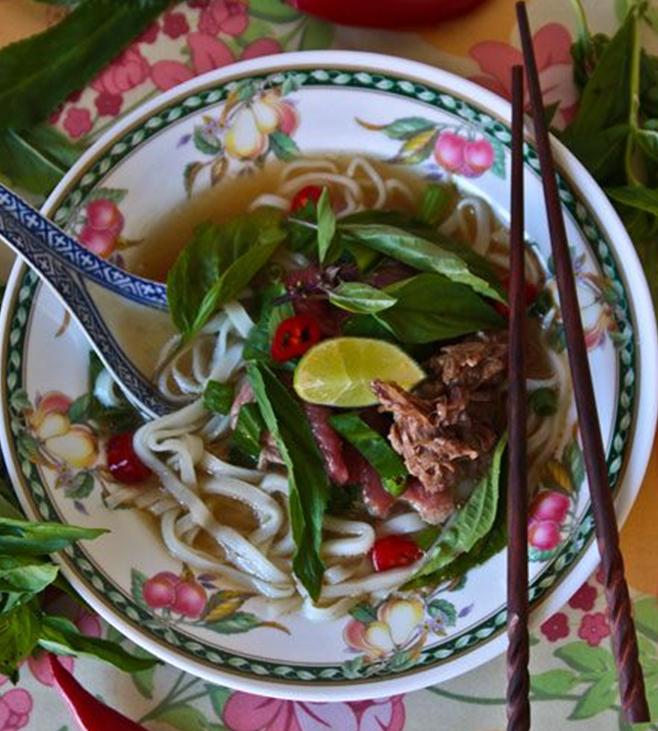
It does take some time and most of that time is really in the making of the broth which, if done well, is layered and deeply flavoured with hints of star anise, cardamom, ginger and cassia. Many purists will say not to rush it and I can imagine that it would certainly affect the flavour of the broth as I saw it change over time. But once it is simmering you really don’t have to do much except for skimming it once every hour or so and it makes a lot of soup-I ended up with about 4-4.5 litres of it which was perfect for freezing and using if you are in need of a hit of pho. There is a deeply sustaining fragrant beef broth, thinly sliced beef tenderloin which is served raw but then cooks in the steaming hot soup. This contrasts with the soft beef shin meat, heat from the chilli and freshness from the sheaf of mint, Thai basil, eryngo and green onion.
Luke recalls times making the pho broth. He would start it the evening after service had been completed as he needed the whole kitchen for it. He would then leave it overnight with the lid on low heat. “I’d come back in the morning and as I came down Crown Street I could smell it. I’d turn the alarm off and open it and it’s my favourite part of the day opening the broth up and eating the meat that has been braising.”
Pho Bo
For broth :
- 2 kg beef shin bones
- 5 litres water
- 4 eschallots
- 1/2 onion, charred (to help bring out the flavour)
- 50-60g ginger, peeled
- 1 fat cassia stick (Vietnamese cassia looks like tree bark)
- 3 pods of Vietnamese cardamom, crushed lightly so that they are opened (quite different from regular cardamom)
- 4 star anise
- Chicken powder, salt, sugar and fish sauce to taste
For noodles, beef and garnishes
- 300g beef tenderloin
- 500g fresh rice noodles
- Thai purple basil
- Mint
- Eryngo (Vietnamese or French coriander, different from other coriander, use coriander if you cannot find this)
- 1 x lime, quartered
- 1 large red chilli, sliced
- Green onions
- Bean sprouts and any other green Asian vegetables chopped up
- Some of the soft meat from the beef shin
*All the ingredients can be found in local Asian markets (Fu Tai in Cotes des Neiges Plaza is one and another is Kim Phat off Taschereau blvd on the South Shore.)
Preparation
Step 1 – Put a kettleful of water on to boil and pour it over the beef shins to get rid of any bones and dirt. In a very large pot (I used my largest pot that could fit 10 litres), put 5 litres of water on to boil. Once boiling, add the bones and simmer for 3 hours. Every hour or so skim the fat from the top and remove the scum using a slotted spoon. There will be quite a lot of fat coming from the shins from the marrow etc.
2.After three hours, add the eschallots, onion, ginger, cinnamon, Vietnamese cardamom and star anise and simmer for two and a half hours. I asked Chef Hung if I should add these at the beginning but he recommended against it as he said that it would be too strong. When this is done, do a final skim for fat and scum and strain the soup. Remove some of the meat from the shin bones and keep the broth hot.
The final broth ready
Step 3 – Slice the beef tenderloin very thinly, as thin as possible as you want the hot soup to cook it. It is easiest to do this when it is frozen or partially frozen. Place a handful of fresh rice noodles and the thinly sliced beef tenderloin in a bowl. Add a little of the meat from the beef shin. Ladle over with the hot soup which will cook the raw beef and change it from pink to grey. Serve with fresh Thai basil, mint, eryngo, lime, chilli and bean sprouts and add these as you feel like.

