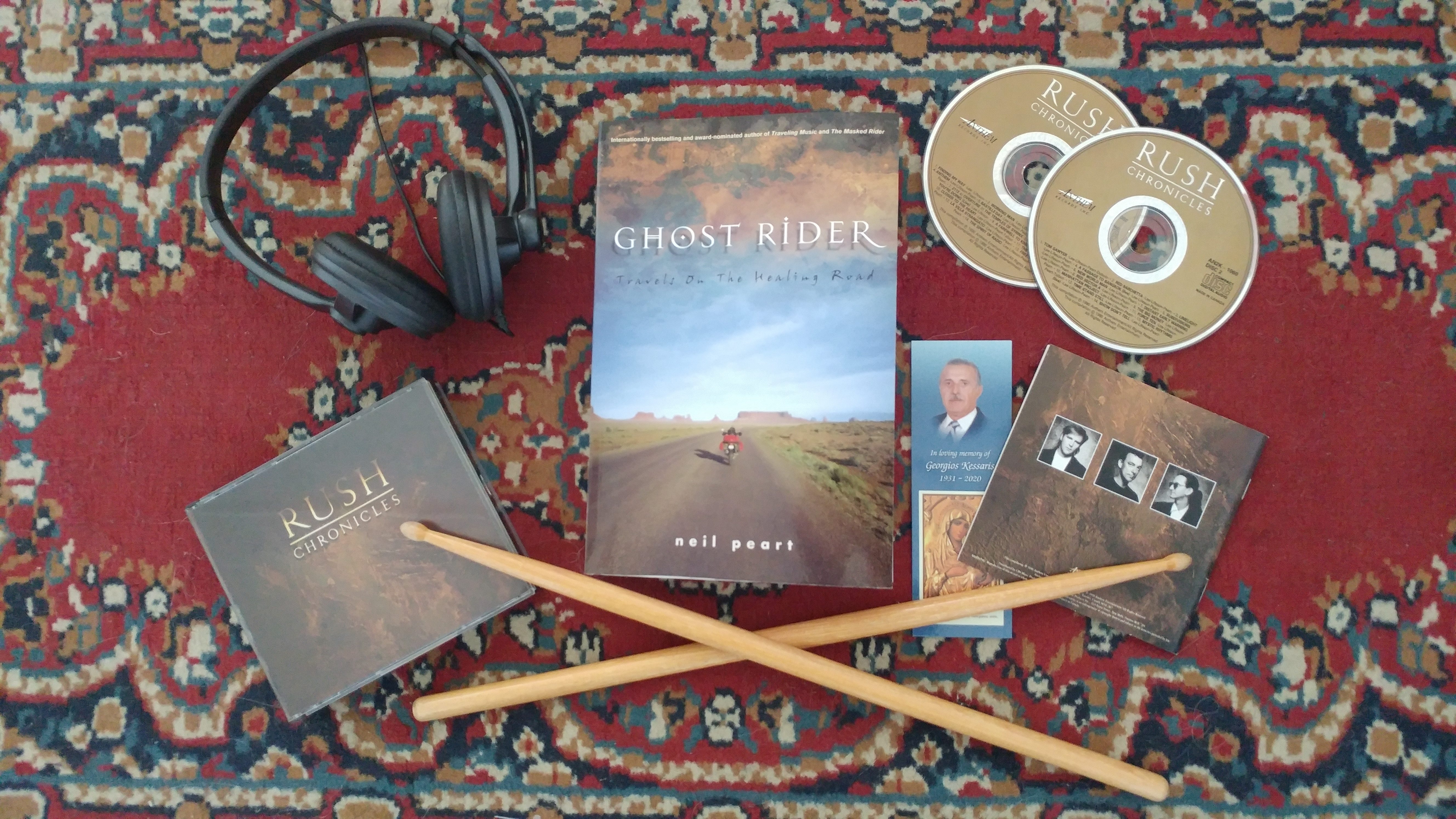
“Parking my motorcycle in front of a motel at the end of a long day on the road could certainly be sweet, like finally exhaling after holding my breath all day, but best of all was setting out in the morning. Whatever torments the night had brought; whatever weather the new day threw at me, when I loaded up the bike and swung my leg over the saddle, my whole perspective changed.”
-Neil Peart (from Ghost Rider, page 41)
I remember when I heard the news: Early evening on Friday, January 10th 2020. I was in my car on Beaumont Avenue headed home listening to CHOM FM. Sharon Hyland came on the radio and announced that Neil Peart, the legendary drummer Rush, had died several days earlier at the age of 67. I was shocked. I didn’t even know he was sick. He was, in my opinion, the greatest rock and roll drummer ever (with all due respect to John Bonham and Keith Moon, both rock gods, but when you think about it most songs by Led Zeppelin and The Who were less than 5 minutes long and almost all where in 4/4 time). For me it signified another milestone in the decline of popular music. It made me recall a time before digital sampling, electronic music and auto-tune, when progressive rock musicians worked hard at their craft and acquired skills only after endless hours of practice and sacrifice, and not winning their careers on game shows sponsored by poisonous energy drinks. (I once saw in interview with Neil Peart where he said he never got tired of playing the song “Tom Sawyer” live because it was such a difficult song to play. That is dedication!)
Over the next few days I found myself posting clips on social media as a tribute to Peart. A friend of mine recommend that I take a look at one of his books, Ghost Rider: Travels on the Healing Road, written after Peart decided to tour North America alone on his BMW R1100GS motorcycle as a way of coping with losing his teenaged daughter and long-time partner in less than a year. I decided to read and review it for Curtains Up.
About a quarter of the way through Ghost Rider, I lost my father at the age of 88. I went to see him, like I did every Saturday afternoon since he went to live at a chronic care facility, not knowing what to expect. My brother told me the day before that Dad had been put on a respirator, but I did not grasp the seriousness of the situation. When I arrived he was non-responsive. My aunt was there along with my father’s wife. They left the room for a few moments to give me some time alone with him as I held his hand and said goodbye. The next day my brother called me at work and told me he was gone, passing away peacefully surrounded by loved ones. After the funeral I went back to Ghost Rider with an entirely new perspective.
I thought making a connection with my situation and Peart’s would be a stretch; my father’s death was expected; there was no tragedy. He lived a long life, becoming a father, grandfather, and step-great grandfather; he was a sailor who saw the world; he was married 3 times, was twice a father, and twice a stepfather. I recall having a coffee with him when he was about to turn 71 and going to retire after being a taxi driver for almost 40 years. He said he didn’t care if he died tomorrow, he just didn’t want to be sick. His retirement was well-earned, long, and he enjoyed every minute of it. Peart’s daughter Selena, on the other hand, died in a car accident on her way to college. She had her entire life ahead of her. Peart’s partner Jacqueline Taylor died of cancer less than a year later in her 40’s, still lamenting her only child. But the more I delved into Ghost Rider, the more I realized that sorrow is sorrow, loss is loss, and inside we are all the same.
Peart’s effort is more than a book on dealing with losing loved ones; it is also part travel log, and part rant; it contains numerous letters to friends that really get into the soul of a man trying to put himself back together again, with a rawness that on one occasion gave me goosebumps. As well he peppers the book with lyrics from Rush songs (most of which he wrote, being the band’s primary lyricist). At times his quirky humour shines through, at other times you can feel the pathos, like on page 80:
“…I saw other people with their children, or with their lovers and mates, or even just apparently enjoying life, it wasn’t so much ill will that moved me, as it was jealousy, resentment, and a cruel sense of injustice.”
Or on page 257:
“So those of us on the ‘inside,’ like you and me, are trying to ‘accept the unacceptable.’ We’re expected to pull ourselves together and carry on…but we face a pretty desperate battle, after all, for there is nothing to pull together!”
Peart’s insight is deep and often profound. His observations cut right to the heart of grief and feelings of isolation and betrayal to the point where he believes he will “…never trust Life again.” (Page 257) The author for the most part avoids getting preachy, the only exception being on pages 258-262 where in a letter to one of his friends he outlines 5 directives for dealing with emotional pain based on his experience, all of which are astute and helpful.
The most eerie and prophetic moment comes on page 84 where Peart contemplates the emptiness of his existence exclaiming “’I’ll never get to be a grumpy old grandpa!’”
But it is also satisfying and inspiring to watch Peart slowly emerge from the haze and reclaim his life and happiness.
So what was I left with after reading Ghost Rider, and from my own experience? I learned it is okay to mourn, but don’t get wrapped in grief; stay in touch with loved ones, and don’t fall into the trap of self-pity; celebrate the lives that were, and stay active; don’t shut down, don’t shut out. And don’t be afraid to let someone new into your heart.
We live in an era of Oprah-inspired quasi-experts who flog books of quick fixes and catch phrases claiming that have it all figured out; that they have all the answers if you just buy their product, follow them like a messiah, or give them a daytime TV show. For me, Ghost Rider: Travels on the Healing Road, a simple amalgamation of travel journals, letters, and lyrics, written by a rock and roll drummer, is what I would recommend to anyone dealing with profound loss.
Twitter: @Akessaris
Facebook: https://www.facebook.com/groups/7075798898/
Instagram: https://www.instagram.com/andreas_kessaris/?hl=en
