Mitchell Field for Curtains Up
RECAP: Montreal Mid 1970’s
I had received a frantic phone call from a booking agent. He needed a last minute replacement drummer for B.B. King and John Lee Hooker. Throwing my drums in a cab I rushed over to the Capital Theatre on St.Catherine Street. I quickly set up my drums. No rehearsal, no sound check, no set list, and (most troubling of all) no John Lee Hooker!! It’s ten minutes till show time.
PART 2
Facing The Back Of A Legend
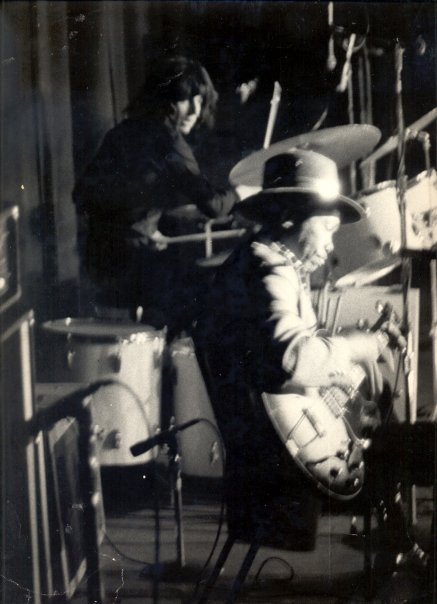
Seven minutes till show time. A white Cadillac limousine screeches to a halt outside the artists’ entrance. A tall black man in a purple Panama hat stumbles out. It’s blues legend John Lee Hooker. He travels alone – no entourage. He carries one bag and his guitar case. He lurches his way to center stage, sits on a stool, and unpacks his most cherished possession – a vintage Gibson sunburst.
I can see deep scratches on the guitar’s body. A testament to years on the road and the toll it takes on instruments and the people who play them. Without a word he nods to the bass player whom he seems to recognize. Then he sizes me up. Looking at my elaborate seven piece drum set he shakes his head and sighs “Another white boy” he mutters.
Like a lot of veteran blues acts Hooker doesn’t have his own band. He prefers to use “pickup” musicians supplied and paid for by the promoter. This lowers his cost of touring, but the level of musicianship varies wildly.
I saw Chuck Berry on back to back nights in two different cities with two different bands. The first show was awful. To call it sloppy would be praising it. Erratic tempos collided with out of tune guitars and a sound mix from hell to form a huge wall of sonic shit. It was sad to hear iconic tunes like “Maybelline” and “Johnny B Goode” mutilated beyond recognition. Berry didn’t seem to mind and I got the impression he was on automatic pilot, just going through the motions for a pay check.
The second show was the complete opposite. With a different drummer and bass player and the same set list. Those songs came to life delivered with a reverence that was missing the night before. Every lick and back beat was right on the money. “Oh Carol” never sounded better and “No Particular Place to Go” (“Hail, Hail Rock and Roll”) reaffirmed why Chuck Berry has been called “America’s greatest rock & roll songwriter”.
After the show I managed to bluff my way backstage and there standing in the hallway was Berry. I was a seventeen year old Jewish white boy within groveling distance of one of my idols. I walked right up to him, introduced myself, and rather than repeat the phrases he had heard so many times from so many fans through the years I said ”Mr. Berry may I ask you a question?” “Sure kid” he replied “Why don’t you have your own band?” I asked. Without missing a beat he threw back his head and laughed till he was shaking like jello in an earthquake. When he finally “composed” himself (sorry) he put his arm over my shoulder and said “Kid, I don’t need a band because everybody knows Chuck Berry’s music”.
Hooker operates on the same principle. He doesn’t see the need for rehearsals or showing up for scheduled sound checks; however, his influence on music can’t be denied. His signature boogie guitar riff has become part of the DNA of rock & roll (as important as Chuck Berry, Bill Haley, and Les Paul among others).
Many of today’s musicians owe a huge debt of gratitude to John Lee Hooker. The Animals recorded his tune “Boom Boom” in the mid 1960’s and his trademark riff appears on such classic hits as “Canned Heats”, “On The Road Again”, and one hit wonder Norman Greenbaum’s “Spirit In The Sky” (a lost treasure worth a listen. John Lennon called it “the best song” he had heard that year). ZZ Top and George Thorogood can also trace their musical roots back to seeds planted by John Lee Hooker.
It’s show time. I am onstage behind my drum kit facing the back of a legend. As the curtain begins to rise Hooker turns to me and in a voice that sounds like broken glass he growls “Just follow my foot and don’t over play”. Words of wisdom delivered in a blast of whiskey breath.
He had no way of knowing that I was very familiar with his repertoire and his contemporaries: Lead Belly, Howling Wolf, and Muddy Waters. I had researched the pioneers of the blues and learned their story long before I attempted to play their music.
A sad reality of the music industry is that most of the innovators of the blues made very little money from their early recordings. Record companies were mostly owned by white business men who often took advantage of the poorly educated musicians. Artists were pressured to sign complicated contracts they couldn’t even read! Many signed with an “X”. They were paid a low one time fee forever robbing them of future royalties and even songwriting credits. This trend continued into the 1950’s. An example would be Elvis Presley who is listed as a co-writer on many of Otis Blackwell’s #1 hits that Elvis recorded.
John Lee Hooker was told he could only record once per day under his own name. This was to prevent him from being paid twice. From that point on Hooker recorded under many aliases including Johnny Lee and Little John Hooker. This trick allowed him to perform on multiple recording sessions in a single day and maximize his earnings (a very smart move).
It’s been said “the blues consists of three chords and the truth” unlike rock & roll which is three chords and a lot of attitude. My respect and understanding for those who came before me came in handy that night. Call it a case of preparation meeting opportunity.
The ninety minute set flew by without a hitch. A seamless blur. Magic captured in the moment then released never to be repeated again. Today in the digital studio age we have the advantage of many different “takes” to choose from and an endless bag of tricks. Then you add more software tools like auto tune for singers who can’t sing. Next you quantify and cut & paste your “product” until it ends up with a glossy sheen that, for me, represents the soulless corporate sound that is so prevalent in today’s music.
Performing live on stage is a completely different experience. There are no retakes. Mistakes happen, lyrics are forgotten, and guitar strings break mid song. But it’s real and organic the way music was meant to be. Sometimes a unique chemistry is established between musicians even if they have never played together before. Cues are given non-verbally almost telepathically. It’s because we have all read the same book of rock and roll and are on the same page. I believe the audience senses this and a bond is established. This creative connection is the main reason people remember their favorite concerts years after the last chord has faded.
Whenever I am on stage it’s almost an out of body experience. I use a technique that combines total concentration and complete relaxation. For example, when I play the drums and sing I have to divide my brain into five separate parts. Today it is known as multi-tasking, but with years of practice it becomes second nature like breathing. Actors call it muscle memory.
The curtain falls. The show is finished. My brief moment in the spotlight is over. John Lee Hooker has barely acknowledged me yet I am on cloud nine. I did it!
The theatre is empty. Only the road crew remains. They are the true heroes of the music business. They do the heavy lifting the audience never sees. Driving all night to setup again before the band arrives for sound check. Living on a diet of coffee, cigarettes, fast food, and very little sleep. Faces in the dark, but an essential part of any tour.
I pack my drums knowing that in a few hours I have to be back at high school. I am standing at a cross road. How long can I keep up this double life of student by day and night club performer by night?
B.B. King (a real gentleman) invites me to the after show party at the Chateau Champlain. How can I refuse? At that moment I make a decision: Goodbye Outremont High School…Hello music full time.
As I walk off stage a gravelly voice calls out “Hey kid”. I stop and turn. It’s Hooker. “Good job” he says “See you at the party”. He climbs into his limousine and disappears into the Montreal night…. I never saw him again.