By Andreas Kessaris for Curtains Up! (@AKessaris)
“It’s impossible to describe what it feels like to be handed the same award that was given to Paddy Chayefsky thirty-five years ago, for another movie with Network in the title…The commoditization of the news and the devaluating of the truth are just a part of our way of life now. You wish Chayefsky could come back to life long enough to write The Internet.”
-Aaron Sorkin
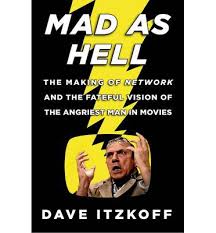
I have often said that the 1970’s was the last great era for Hollywood pictures. It was a time when budgets were small and studios, writers, actors and directors were willing to take bold risks, and delivered uncompromising, hard-hitting films that became cultural icons. One such motion picture is topic of Mad as Hell: The Making of Network and the Fateful Vision of the Angriest Man in Movies by New York Times reporter Dave Itzkoff.
Mad as Hell recounts the story of the classic movie Network from inception to legacy. Reading the book it became clear to me early on that Itzkoff is, like most NYT staffers, a skilled writer and journalist. The narrative progresses smoothly and is never sluggish or trite; the well-organized material efficiently presented. It is not uncommon for such books to get bogged down in industry jargon, making it inaccessible to people who are not in or into behind-the-scenes show business stories, but the author cleverly avoids such pitfalls.
The bios of the principals involved are short but interesting and informative (Mad as Hell focuses primarily on Network’s screenwriter, the award-winning Paddy Chayefsky, and Peter Finch, the actor who brilliantly brought his prophetic words, not to mention the unforgettable “Mad as Hell” rant, to life). However others seemed incomplete. While Itzkoff recalls what happened to most of the main characters after Network’s theatrical release, for me there are two glaring omissions. We are told details of how Chayefsky, Finch and William Holden met their ends, but for some reason the author felt no need to relate to us of the fate of the film’s acclaimed director, Sidney Lumet (he died of lymphoma in 2011) and producer Howard Gottfried (I could not find out myself on IMDB if he was even still alive).
The only time Mad as Hell goes awry is in Chapter 7 with a long, distracting digression about Vanessa Redgrave’s controversial Oscar acceptance speech that has little if anything to do with the subject matter of the book (although I do appreciate that Itzkoff did fairly quote everything the aforementioned actress said that evening and the background story leading up to that moment rather than the one brief part that is frequently cited out of context; can’t beat that NYT journalistic integrity).
Whenever I read a book I plan to review I keep a legal pad and pen by my side, usually to make note of perceived faults. In this case said comments were less than half a page (always a good sign). In short, Mad as Hell is the best biography of a movie I have read in a long time, and is everything As You Wish (the story of the making of The Princess Bride), failed to be.