
Mitchell Field for Curtains Up
Picture a set of drums in your minds eye.
Imagine yourself sitting behind it.
Focus on the drum sticks in your hands.
What is the first thing you would do?
Let me guess. You would beat those poor drums like a used rental car. Its only natural…rhythm is part of our DNA. It’s primal.
Feel the exhilaration as adrenalin kicks in. Grinning like a poet on payday you quickly transform into Animal from The Muppets. All your stress & worries disappear as you lose yourself in a fog of crashing cymbals and bedroom mirror fantasies.
After a few minutes of mindless banging you notice your energy begins to evaporate. Your heart beat and blood pressure will be racing. Maintaining a steady beat will become more difficult. Coordinating the foot pedals will frustrate you. Playing four different beats at the same time requires total concentration and complete relaxation. It’s a tough combination to master.
Without guitars, keyboards, and vocals the melody and harmony will be missing. Your dream of being a famous drummer in a rock & roll band quickly fade. It seemed so easy. What happened? The sound you just heard was reality kicking your butt. The number of drummers who actually make millions of dollars is a very select few, but don’t let that stop you. Someone has to do it.
A Quick History of Drumming
Remember Roman slave ships? If you said yes you must be very old! The speed of the oar strokes was based on a drum rhythm. Many years later when military drummers led troops into battle they had no written music. They invented a language to describe drumming in verbal terms.
Rudiments
Rudiments are the basic vocabulary of drumming. Knowing which hand to use and when are called “stroke techniques”. Drum nerds will tell you these exercises are called paradiddles, but I won’t. For the best example of really complex drumming patterns performed with ease I highly recommend you listen to Buddy Rich. He is considered by many to be the greatest drummer of all time. His incredible speed and technique were legendary. He could make the drums sing.
I have been a professional drummer for over forty years. I have played gigs in clubs in front of less than 10 people. I have also opened for The Cars at Maple Leaf Gardens in front of 20,000 people.
Opinions differ on the tools required to be a good drummer. During my research for this article I tried to be objective. I took off my “drummer’s hat”. I reviewed hours of DVD’s, print articles, web sites, drummer magazines, and theory manuals. I attended several seminars and drum workshops. I also made a point of getting feedback from a half dozen mates of mine who pound the skins around town. The seven areas that are fundamental to a drummer’s musical development were best expressed by drum guru Pete Sweeney (author of “The Complete Drum Set Method”). He described the skill set as “The 7 C’s”
“The 7 C’s”
1 – Concentration: The ability to practice or play many hours with focus.
2 – Coordination: The ability to play different beats with hands and feet simultaneously.
3 – Consistency: The ability to perform correctly every time.
4 – Conception: The ability to see the big picture & how to play different musical styles.
5 – Composition: The ability to improvise instantly.
6 – Creativity: The ability to use your musical imagination.
7 – Confidence: Knowing you can perform anything with a high degree of skill and certainty.
Drummers’ wives and girlfriends insisted I add another C…Crazy!
The Drum Set Evolves
The first drummer to focus the public’s attention on the instrument was Gene Krupa. His swinging anthem “Sing, Sing, Sing” featured one of recorded music’s first drum solos. He was a showman who insisted that his drums be placed at center stage. His animated playing and stick twirling antics thrilled audiences during the big band era of the 1940’s.
His drum set was very basic: four drums and two cymbals. The look of the drum set changed during the late 1940’s. Louie Bellson and Ed Shaughnessy (The Tonight Show drummer) added a second bass drum and created rhythms never heard before.
By the late 1960’s Mitch Mitchell (Hendrix), Ginger Baker (Cream), and Keith Moon (The Who) were using two bass drums and multiple cymbals. It was partly an effort to be heard above the giant amps all turned up to the “11” button.
During the self indulgent 1970’s three piece bands became known as “Power Trios”. Without keyboards or a second guitar the drummer had more room to fill and twenty minute drum solos were a staple of concerts at The Forum (Emerson Lake & Palmer and Vanilla Fudge).
Today, Metal and Speed Metal drummers (Slayer, Metallica) use a device called a double pedal. It’s actually a single pedal that allows the drummer to strike both bass drums at the same time. Purists call it cheating. John Bonham (Led Zeppelin) proved that anything played on two bass drums he could replicate on one. Even the way Bonham tuned his drums added to his explosive tone. By using an oversized 26 inch bass drum his drums sounded like cannons. Take a listen to Moby Dick.
“Less Is More…More Or Less”
Most great drummers play simply (Ringo, Charlie Watts, Don Henley). They understand their role in the band. They are the timekeepers.
If all drummers play the same beats what makes then different from each other? Every drummer has a unique and individual style. No two drummers play the same song the same way. There are always variations. Some drummers are known for their technique: Neil Peart (Rush) and Billy Cobham (Mahavishnu Orchestra). Others favor raw power: Tommy Lee (Motley Crue) and Keith Moon (The Who). This is called the “Attack Ratio”.
Keith Moon – Chaos Theory
I was blessed to see Moonie perform live more than a dozen times. When I was ten years old I snuck in the back door of The Marquee Club in London. It was the night Pete Townsend threw his guitar in the air and it smashed into the low ceiling. He couldn’t get it out. Finally in frustration he ripped down the ceiling, grabbed the guitar by the neck, and smashed it to pieces. I was hooked. The next set he started doing the famous “windmill” strum that became his trademark. Years later he admitted he stole the move from Keith Richard. When asked about it Keith said he didn’t remember ever doing it.
When I was thirteen years old I saw “The Who” at The Forum using a fake pass that I had manufactured. I was able to watch the entire show from backstage. I was six feet away from Keith Moon. I have no words to describe the impact it had on my life. I knew I was looking into my own future.
Moon did all the things drum teachers tell you not to do including blowing up his drums. To see what happened when Moon went too far check out The Who’s performance on The Smothers Brothers TV show on You-Tube. Witness for yourself the full fury of Rock & Roll.
Ringo

The Beatles
“We really started to think we needed the greatest drummer in Liverpool and the greatest drummer in our eyes was Ringo Starr” – Paul McCartney, 1962
“I was still playing with Rory Storm & the Hurricanes. I started to go and watch The Beatles. I loved the way they played, I loved the songs, the attitude was great, I knew they were a better band than the one I was in” – Ringo Starr, 1962
The drumming on “Rain” stands out for me because I feel as though it was someone else. I was possessed” – Ringo Starr, 1966
“I could always tell which were John’s songs. I preferred to play on them, they always had a bit more Rock & Roll to them” – Ringo Starr, 1966
The Rhythm Section
A drummer doesn’t play chords or melody. The drummer’s job is to create and maintain the beat (also called tempo, feel, or the groove). Think of a piston in a car engine. A drummer in a band is that piston. If the timing isn’t consistent the engine won’t run smoothly. Drummers combine power and precision to drive the band forward. Without a drummer’s energy fueling the pistons the car won’t move.
The drummer and bass player in a band are called the rhythm section. Most traditional bass guitars have four strings and the bass player usually plays the main note of the chord. In musical terms we refer to this as the “root”. There are other names for it, but who cares. For those who do care you can also call it the “tonic”. For the anal retentives out there (you know who you are) you can call it the “inverted interval”.
It is critical that the drummer and bass player pay close attention to each other. If a drummer is playing one pattern and the bass player is playing a different pattern it won’t mesh. It will create a herky-jerky feel. It won’t flow. The rhythm section must interlock and function as a single component. This forms a solid foundation that will support the other musicians.
The electric guitar has six strings. The guitarist plays scales and solos around chords that follow each other in a chain. Musicians call this sequence a chord progression, but you don’t have to. The guitarist also has to memorize all those rock star poses.
Once you add keyboards, singers, and horns into the mix there has to be a structure. Who plays what and when?
The Arrangement
Every song has a shape based on musical logic. Think of it as a melodic road map. Arrangements are formulas musicians repeatedly use because they work. Not all musicians read and write music, so a shorthand has evolved. For example, if we call the verse section “A”. The chorus section “B”. And, the middle section (The Bridge) “C” we can then write a simple arrangement that looks like this: ABABCB (verse, chorus, verse, chorus, bridge, chorus). Using this technique, arrangements can be worked out quickly.
In a more casual situation (jamming with friends), songs are just called out and played from memory without any preparation. Since there is no audience or pressure it’s okay if someone plays the wrong chord. No one yells at you…that’s Rock & Roll.
Syncopation
Definition: To shift the emphasis to the “weak” beat. For example: Count 1, 2, 3, 4. Tap your foot on the 2 and 4. Now count 1and 2 and 3 and 4. Tap your foot on the “and”. One is the down beat “and” is the up beat. By shifting the tap on 2 to the “and” of 2 you now have syncopation. The weaker part of the beat is now emphasized rather than the first part of beat 2. See how easy that was?
A recent autobiography on James Brown was titled “The One”. Most people thought it referred to the artist. It didn’t. James Brown often accented the “One” beat of the bar. He believed that emphasizing the first beat made the rhythm stronger. Many James Brown hits feature these two forms of syncopation. Suggested listening: “Get Up”, “Cold Sweat”, and “I Got The Feeling”. For more examples of syncopated drumming check out “What Is Hip” by Tower Of Power/David Garibladi and “Sussidio”/Phil Collins.
Afro-Cuban and Latin Influences
Unlike Rock & Roll bands which focus on loud distorted guitars and smoke bombs, Latin music is percussion based combining congas, bongos, timbales, and cowbells. Each drummer plays a different rhythm to create syncopation. The beats collide to create a wall of drums that build to a crescendo (think of the Tam Tam). The king of the timbales was Tito Puente. I highly recommend would be drummers to familiarize themselves with his brilliant work.
Carlos Santana used blistering single note solos and Afro-Cuban beats to open up the ears of a new generation to musical possibilities that extended far beyond the Blues and Rock & Roll. His drummer Mike Schrieve was only sixteen years old when he performed “Soul Sacrifice” at Woodstock. A must see for any aspiring drummer.
“Timing Is Everything…Just Ask Charlie Watts” – Keith Richards
Charlie Watts is considered by many to be one of the top Rock & Roll drummers. His meat and potatoes approach has been the back bone of the Stones for fifty years. Just take a listen to “Start Me Up”.
His first love is Jazz. In the 1980’s he toured the world with a huge band. In 1991, he organized a quintet that paid tribute to sax legend Charlie Parker.
Montreal has also produced its share of remarkable drummers. Corky Laing/Mountain
Jerry Mercer/April Wine, Dave Devine/Freelance and Norman Villeneuve/Jazz
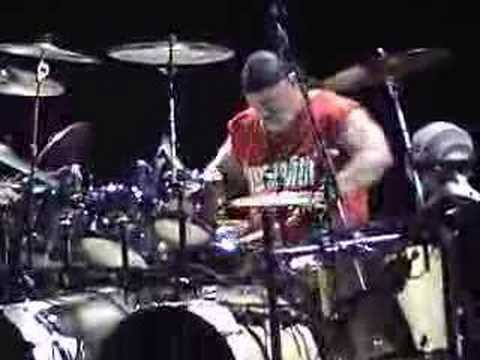
April Wine
The Runaways, Go-Go’s, and Bangles all featured female drummers proving its no longer a mans world. Be sure to check out Sheila E/Prince and Meg White/ White Stripes, Karen Carpenter, and Regine Chassagne/Arcade Fire to compare their different styles.
Putting on my drummer’s hat, some personal faves include Dave Grohl/Foo Fighters, Stu Copeland/Police, Bun E. Carlos/Cheap Trick, Keith Moon/Who, and Ian Paice/Deep Purple.
Drumming is a very personal experience…you do it alone. No one helps you. Knowing what to play and when CANNOT be taught. It’s instinctive. Knowing what NOT to play is a learning curve that never ends. Like any profession drumming requires practice and passion.
The Longest Journey Starts With the First Step – Chinese Proverb
It’s never too late to start playing the drums. This applies to ANY instrument. My hope is that this article will inspire and encourage you to give it a try. Don’t be shy. Don’t have drums? No problem. Visit Steve’s Music or Drum Bazaar and they will be glad to let you have a bash. Added bonus…chair is provided.
As always, I welcome your questions and feedback. Till next time…The Beat Goes On.


That was a brilliant read , thanks! See you on the 5th.
Hey Mitchell, now that was a great article , a big tip of the hi-hat to you!!